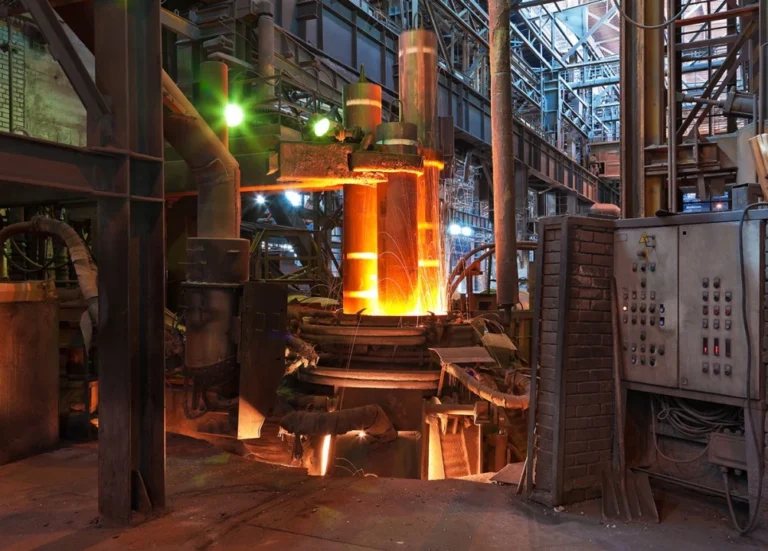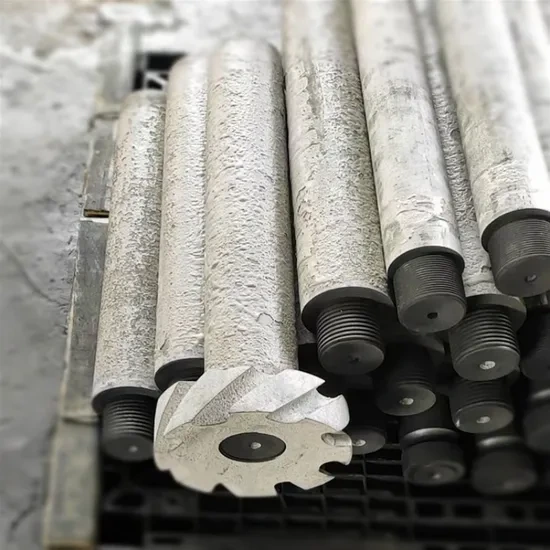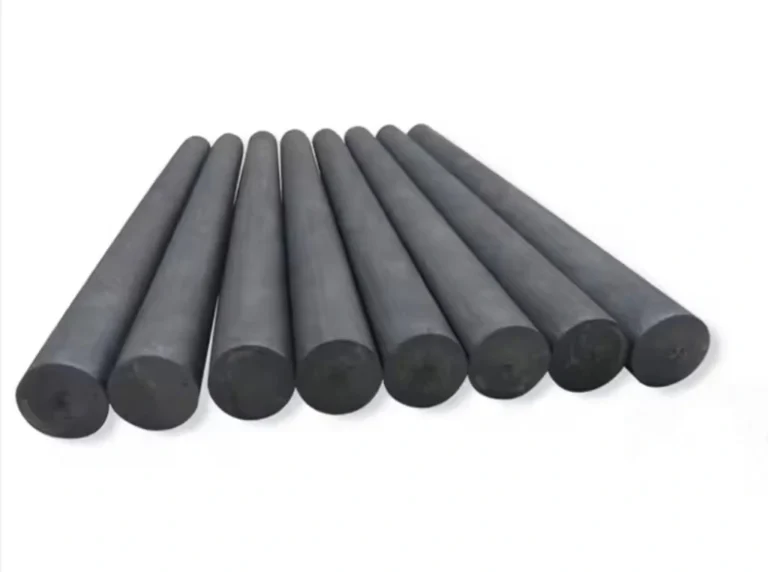
Production of precious metals requires highly specialized equipment. Since the production of precious metals such as gold, silver, and platinum entails the use of heat and pressure, the proper choice of mold material is crucial in ensuring that production is both cost-effective and high-quality. This is the reason why graphite casting molds have become commonplace in recent years.
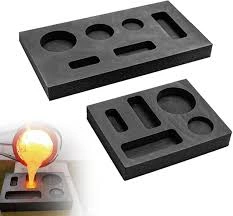
1.Graphite Casting Molds Perform Well in High Temperatures
Melted precious metals need high temperatures; for example, 961.8°C is required to melt silver, while 1,064°C is needed to melt gold and 1,768°C to melt platinum. Traditionally used metal or ceramic molds can hardly work under these circumstances because they usually tend to warp, crack, or degrade quickly.
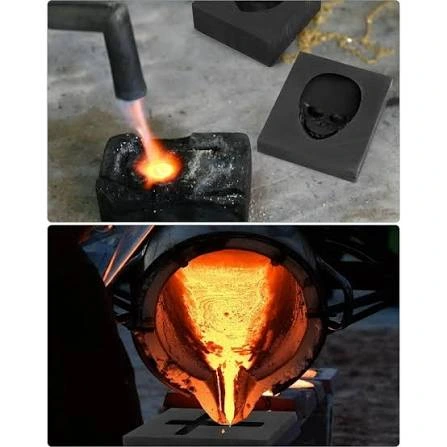
Nevertheless, graphite performs excellently well in such circumstances due to the following two properties:
High Resistance to High Temperatures and Refractoriness: High-purity graphite is not prone to melting because it sublimes at 3,650°C. Also, graphite is able to operate perfectly at temperatures of 3,000°C and above when there is a covering of an inert gas.
Thermal Expansion Is Very Low: The thermal expansion coefficient of graphite is relatively low (2.0 × 10⁻⁶ ÷ 3.0 × 10⁻⁶ /K). As it hardly expands or contracts, it is capable of enduring thermal shock of 1,000°C without getting distorted.
The following table provides a summary of important parameters at high temperatures for various types of molds:
| Mold Material | Max Temperature Tolerance (°C) | Coefficient of Thermal Expansion (10−6/K) | Thermal Shock Resistance |
| High-Purity Graphite | 3000+ (Inert Atmosphere) | 2.2 – 2.8 | Excellent (No cracking) |
| Cast Iron / Alloy Steel | 1100 | 12.0 – 15.0 | Poor (Prone to distortion) |
| Quartz Ceramic | 1400 | 0.5 – 1.0 | Moderate (Prone to brittle fracture) |
Common Mold Configurations in Precious Metal Casting
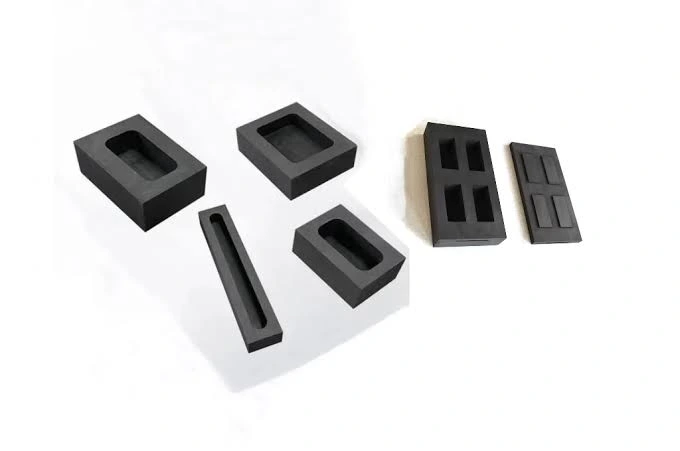
Various types of molds are used in industrial casting processes, depending on the type of manufacturing process intended:
Continuous Casting Graphite Dies: These are mainly used in the continuous drawing of gold and silver wires, tubes, and strips. They have high resistance to wear and thermal fatigue.
Custom High-Purity Shaped Dies (Haoxing Graphite Mold): A representative solution for fine jewelry, high-precision commemorative medals, and complex geometric components. Manufactured from high-density, ultra-pure isostatic graphite, the Haoxing Graphite Mold accurately reproduces micro-scale surface textures and intricate internal cavities during vacuum-suction or centrifugal casting cycles.
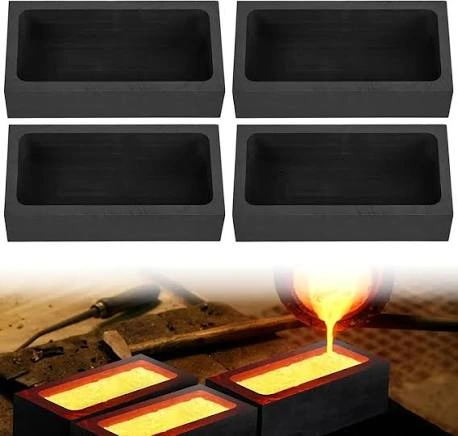
High-Density Graphite Ingot Molds: Engineered specifically for pouring bulk bullion, gold bars, and silver ingots. Featuring thick walls and superior heat dissipation, these molds withstand hundreds of repeated pouring cycles without spalling or cracking.
2. Superior Non-Wetting Property of Graphite Casting Molds for Zero Metal Loss
For precious metal refiners and manufacturers, material yield directly dictates profitability. Any adhesion between molten liquid metal and the mold wall results in expensive material loss and compromises mold integrity.
Non-Wetting Mechanism and Contact Angle Dynamics
Graphite possesses low surface energy. In a molten state, precious metals like gold and silver exhibit high contact angles (typically exceeding 140°) when interacting with graphite casting molds. This intrinsic non-wetting behavior prevents molten metal from chemically bonding to or penetrating the microscopic pores of the carbon matrix.
Simplified Demolding and Maximum Material Recovery
Because liquid metal does not adhere to the surface, solidified castings release effortlessly without requiring chemical release agents. This eliminates chemical contamination of the precious metal melt while keeping wall-sticking losses virtually at zero, drastically raising overall material recovery rates across batch runs.
3. Mirror-Like Surface Finish Enabled by Precision Graphite Casting Molds
High-quality appearance of ingots, bullion coins, and jewelry is a must. The conventional manufacturing technology requires time-consuming grinding, polishing, and/or chemical cleaning stages.
Ultra-Fine Grained Structure & High Precision CNC Processing
Highly efficient graphite molds for casting are produced by high-precision CNC machining of isotropic graphite with an ultra-fine-grained structure (particle size less than 5- 15 µm). As a result of precise CNC milling and polishing of graphite molds, inner surface roughness ($R_a$) can be reduced to below 0.2 µm.
The use of ultra-fine grained graphite molds brings several significant quality benefits:
Decreased Post-Processing: Smooth surface finish of castings allows reducing additional polishing operations.
Preservation of Fine Details: Anti-counterfeiting patterns, brands, and fine text of bullion are well-defined.
Reduction of Gas Porosity: Graphite is characterized by micro-porous permeability that helps to evacuate gases during pouring and prevents pinholes and surface cavities.
4. High Thermal Conductivity of Graphite Casting Molds for Fast and Uniform Cooling
The rate of cooling and thermal homogeneity determine the metallurgical structure of the resulting casting. Inhomogeneous thermal flow leads to shrinkage cavities, cracks, and local stress concentrations in the metal.
Thermal Efficiency and Refining of Grains
Graphite casting molds have a thermal conductivity between 120 W/(m·K) and 160 W/(m·K),
which is comparable to some metallic alloys. Use of graphite casts ensures quick removal of heat from the molten core and ensures directional solidification.
- Reduced Cycle Times: Quick heat removal decreases cycle times per pour and increases production rate.
- Improved Metallurgical Quality: Quick and homogeneous cooling inhibits the formation of large dendritic grains, leading to a dense and coherent microstructure.
Conclusion
As far as high-temperature tolerance, preservation of metals, surface finish, and cooling performance are concerned, graphite casting molds constitute an indispensable resource in foundries dealing with precious metals. By choosing the correct high-purity and high-density graphite casting tools, producers can enhance their products without increasing their operational costs.
If you have any queries about our graphite casting molds’ material quality or custom manufacturing requirements, don’t hesitate to call us at Haoxing Graphite – our technical assistance is always at your disposal!